28 posts tagged with "Architecture"

System architecture patterns and infrastructure design.

View All Tags

Fail Closed, Never Destructive: Inside the Zaris License Lifecycle

· 10 min read
Clustron Team
Distributed Systems Engineering

The Zaris license lifecycle

Licensing is the part of a product most engineers never want to think about, and it shows. The usual pattern is a time bomb: a date is checked, and when it passes, the software punishes you — it throws on startup, it corrupts or wipes local state to stop you "stealing" it, or it simply crashes and takes your data with it. That design treats your own operators as adversaries, and it fails in exactly the moment you can least afford it: in production, after the clock quietly rolled over.

Zaris takes the opposite stance. The license check is a distributed data store's most safety-critical switch, so it's built like one: a single pure, deterministic policy function, a graceful and fully reversible enforcement path that never destroys a byte, and one clock per machine that resumes the instant you activate a key. This post walks through how that lifecycle actually works in the shipping code — because the interesting engineering here is in what it refuses to do to you.

One Log, Two Jobs: How a Replica and a New Owner Catch Up the Same Way

· 12 min read
Clustron Team
Distributed Systems Engineering

Catch up by replaying the log — one revision-ordered op-log feeds replicas and new owners alike

Two very different-looking events in a distributed store turn out to be the same problem underneath. The first: a replica falls behind its primary — a GC pause, a slow disk, a brief network partition — and now holds a stale copy of a partition it must eventually match. The second: a partition is reassigned to a node that has never held it, and that node must acquire the entire dataset from the current owner. One is replication lag; the other is migration. They have different triggers, different operators, different failure stories.

But the question each one has to answer is identical: how do I converge to the current truth of this partition without freezing writes while I do it? Zaris answers both with a single mechanism — a revision-ordered operation log kept per segment, replayed from a known point. This post is about that log: how it's built on the write path, how it's bounded so it can't grow without limit, how it's replayed, and why the exact same substrate carries both a lagging replica and a brand-new owner to convergence.

Big Values, Small Pauses: Large-Object Chunking in Zaris

· 6 min read
Clustron Team
Distributed Systems Engineering

Large-object chunking keeps big values off the LOH

There's a number every .NET performance engineer eventually memorizes: 85,000 bytes. Any single allocation at or above roughly that size doesn't go on the normal small-object heap — it goes on the Large Object Heap (LOH). The LOH is a different animal. It's only collected during a gen-2 (full) garbage collection, and by default it isn't compacted. That combination is fine for a big buffer you allocate once and keep. It is not fine for a low-latency in-memory store that repeatedly writes and overwrites large values.

Picture the workload: big serialized blobs, large JSON documents, images, protocol payloads — stored, updated, replaced, over and over. Every one of those large writes lands a fresh object on the LOH. Because the LOH isn't compacted, freed slots don't merge back into contiguous space; they fragment. And because reclaiming any of it means a full gen-2 collection, the pauses get longer and land more often exactly as the working set grows. For a store whose entire pitch is low latency, that's the wrong kind of surprise.

Zaris ships an opt-in feature to sidestep the LOH entirely for these values. It's off by default, and this post is about what it does, how it works, and — just as important — when you should and shouldn't turn it on.

Elastic Scaling: Adding and Removing Zaris Servers Without Downtime

· 5 min read
Clustron Team
Distributed Systems Engineering

Growing and shrinking a Zaris store live under a supervisor

Capacity is never right for long. Traffic grows, a launch lands, a season ends — and the store you sized last quarter is either straining or half-idle. The question that decides whether that's a chore or a crisis is simple: can you change the size of a running store without taking it down?

For Zaris the answer is yes, with an important asymmetry that's worth being honest about up front. Scaling out — adding servers — is the easy, safe, lossless direction, and it happens live while the store keeps serving. Scaling in — removing servers — is also supported, but it's a deliberate, monitored operation because the data on a departing server has to go somewhere first.

This post walks both directions: growing a store with Add-ZrServer, shrinking it with Remove-ZrServer, why scale-in needs a drain, and where the web console fits.

Pluggable TLS Trust: Four CA Modes for Locking Down Zaris

· 7 min read
Clustron Team
Distributed Systems Engineering

Four CA modes for pluggable TLS trust in Zaris

The fastest way to make sure TLS gets skipped is to force one trust model on everyone. A dev running a store on a laptop doesn't want to stand up a CA. A bank with an offline root in an HSM doesn't want your tool minting certificates at all. Ship a store that only knows one of those, and half your users turn security off to get their work done.

So Zaris doesn't pick for you. Its TLS trust is pluggable across four certificate-authority modes, from zero-config self-signed all the way to certificates you provision entirely out of band. You choose the mode that matches the PKI you already run, and Zaris slots into it instead of asking you to rebuild around it. TLS isn't one-size-fits-all, and treating it that way is exactly why security gets deferred.

Any Language, One Store: How Zaris Speaks the Redis Protocol

· 7 min read
Clustron Team
Distributed Systems Engineering

Any language, one store

Zaris is a distributed key/value store built natively for .NET. Its first-class clients speak an efficient binary protocol, and if your stack is .NET, that's the path you want — real async APIs, .NET types, coordination primitives, IDistributedCache and HybridCache drop-ins.

But most systems aren't only .NET. There's a Python service doing data work, a Go sidecar, a Ruby job runner, a Node gateway. Rewriting all of them onto a new client to try a new store is a non-starter. So in 2.0.0, every Zaris node can also expose a Redis-protocol (RESP2) listener: point an existing Redis client at it and use Zaris as a drop-in key/value store, in any language, without changing a line of client code.

This post is about how that front-end actually works — the routing model, the data model, the failover models, and exactly which commands are in and out.

Zaris 0.9.0 Is Here — and It's Generally Available

· 4 min read
Clustron Team
Distributed Systems Engineering

Zaris 0.9.0 — Generally Available

Today we're shipping Zaris 0.9.0, and with it, Zaris hits general availability. It's production-ready, cross-platform, and now backed by commercial support.

If you haven't run into it yet: Zaris is a distributed, in-memory key/value store for .NET. It's fast, replicated, and you can operate it from a browser, PowerShell, or straight from your app. This release is the culmination of that work — the point where "promising project" becomes "thing you can put in production."

Building Distributed Systems

· 4 min read
Clustron Team
Distributed Systems Engineering

A Practical Guide for .NET Developers

Introduction​

Most backend systems begin their life on a single machine.

An ASP.NET Core application processes requests, a database stores application data, and background workers handle asynchronous tasks such as sending emails or generating reports. In this environment, concurrency is manageable and coordination between components is relatively straightforward.

As the system grows, however, things start to change.

Traffic increases, more application instances are deployed behind a load balancer, and services begin running across multiple machines. What was once a single application evolves into a distributed system.

At this point, the nature of the problem changes dramatically.

The challenges are no longer limited to writing correct business logic. Developers must now deal with coordination across machines, network failures, partial outages, and maintaining consistency across distributed state.

This is where distributed systems engineering begins.
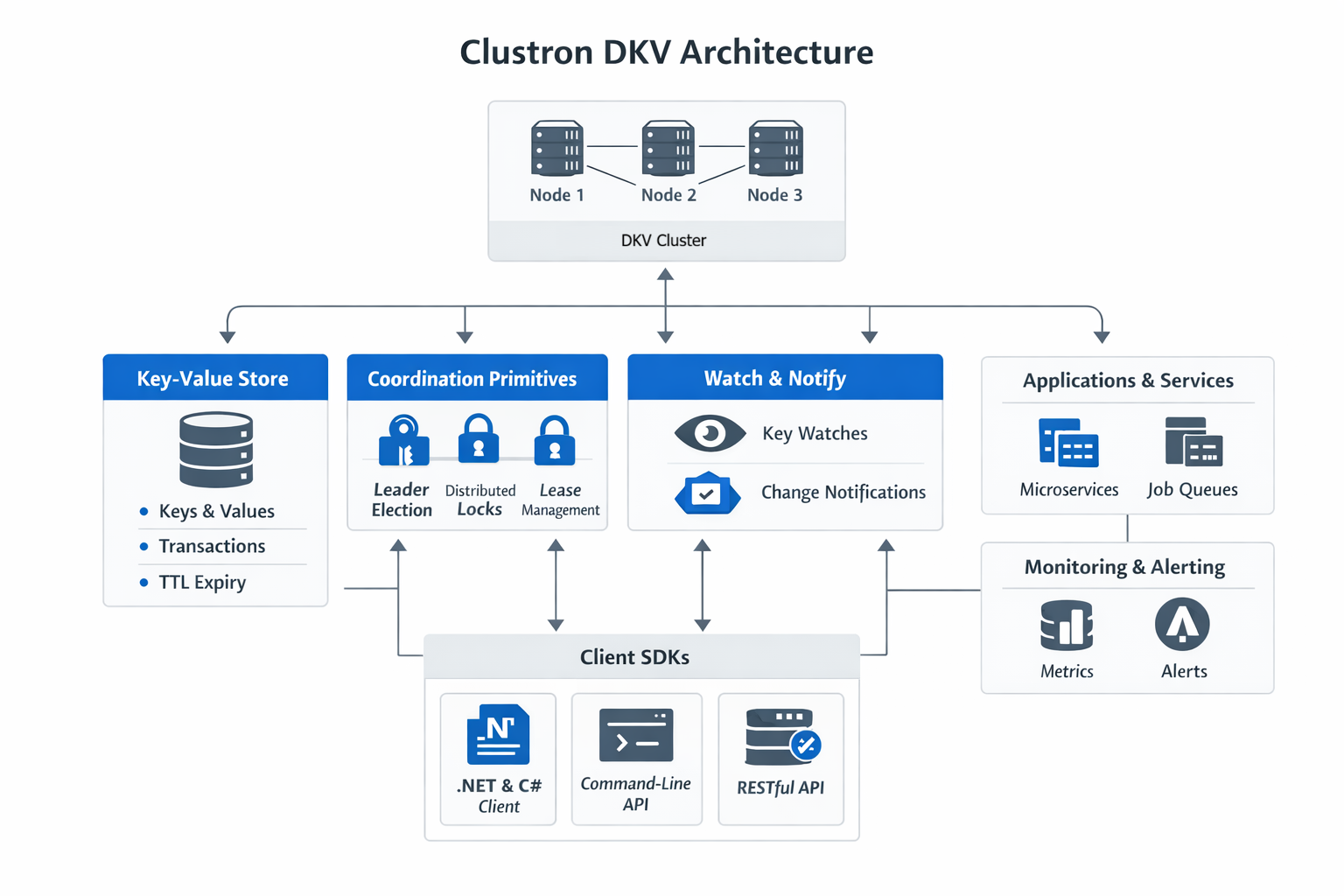

Distributed Systems Architecture


What Is a Distributed System?​

A distributed system is a collection of independent computers that appear to the user as a single coherent system.

Instead of running all logic on one machine, responsibilities are distributed across multiple nodes that communicate over the network.

Examples include:

  • Microservice architectures
  • Distributed databases
  • Clustered caches
  • Message queues
  • Cloud infrastructure platforms

These systems provide scalability and resilience but introduce new complexities.


Why Distributed Systems Are Hard​

Unlike a single-machine application, distributed systems must deal with realities such as:

Network Failures​

In distributed systems, communication happens over a network. Networks can be slow, unreliable, or temporarily unavailable.

A request may fail because the remote node crashed, because the network dropped packets, or because a timeout occurred.

The system must handle these scenarios gracefully.


Partial Failures​

In a distributed system, components can fail independently.

One node in a cluster might crash while others remain healthy. A service instance may restart while other services continue running.

This means the system must operate correctly even when only part of it is functioning.


Consistency Challenges​

When data is replicated across multiple nodes, keeping it consistent becomes difficult.

For example:

  • Two nodes may attempt to update the same data simultaneously.
  • Network delays may cause nodes to temporarily disagree about the current state.
  • A node might crash after performing only part of an operation.

Designing systems that maintain consistent state despite these scenarios requires careful coordination.


Key Building Blocks of Distributed Systems​

Most distributed systems rely on a few core primitives.

Understanding these primitives helps developers design reliable architectures.


Distributed Storage​

Data must often be stored across multiple machines.

This enables:

  • horizontal scaling
  • fault tolerance
  • high availability

Distributed key-value stores are commonly used for this purpose.


Coordination​

Nodes must coordinate actions such as:

  • leader election
  • distributed locking
  • cluster membership
  • configuration updates

Without coordination mechanisms, multiple nodes might attempt conflicting operations.


Consensus​

Some systems require strong guarantees about shared state.

Consensus algorithms such as Raft or Paxos allow nodes to agree on decisions even in the presence of failures.

These algorithms are fundamental to distributed databases and coordination services.


Partitioning and Replication​

Data is typically:

  • partitioned across nodes to distribute load
  • replicated to protect against failures

Balancing performance, availability, and consistency is one of the core design challenges.


Common Distributed System Patterns​

Several patterns appear repeatedly in real-world systems.

Examples include:

  • Leader election for coordinating cluster activities
  • Distributed locks for ensuring mutual exclusion
  • Job queues for asynchronous processing
  • Rate limiters for controlling request volume
  • Transaction protocols for atomic multi-node updates

These patterns form the foundation of many large-scale platforms.


The Role of Coordination Systems​

To simplify distributed development, many organizations rely on coordination systems such as:

  • etcd
  • ZooKeeper
  • Consul

These systems provide primitives such as:

  • leader election
  • distributed locks
  • cluster membership
  • configuration storage

Applications can then build higher-level behavior on top of these primitives.


Distributed Systems in the .NET Ecosystem​

While distributed infrastructure tools are often associated with other ecosystems, .NET applications increasingly operate in distributed environments.

Modern .NET systems frequently use:

  • Kubernetes
  • distributed caches
  • microservices
  • event-driven architectures

As a result, coordination and distributed state management are becoming increasingly important for .NET developers as well.


Final Thoughts​

Building distributed systems is fundamentally different from building traditional single-machine applications.

The challenges of network communication, partial failures, and data consistency introduce complexities that require specialized patterns and infrastructure.

Fortunately, by understanding the key building blocks — storage, coordination, consensus, and replication — developers can design systems that scale reliably and remain resilient in the face of failures.

In future articles, we will explore some of these primitives in more detail, including leader election, distributed coordination patterns, and practical implementations in .NET.