Build Reactive Systems with Clustron Watch
Most distributed systems don’t start out complicated.
They begin with something simple — a loop.
You write a small worker that checks for work:
while (true)
{
    var job = await client.GetAsync<Job>("jobs:next");

    if (job.IsSuccess)
    {
        await ProcessAsync(job.Value);
    }

    await Task.Delay(1000);
}
At this stage, everything feels reasonable. The logic is clear, the system behaves predictably, and there is very little cognitive overhead.
But as the system grows, this pattern quietly becomes one of the most expensive parts of your architecture.
The Hidden Cost of Polling in Distributed Systems
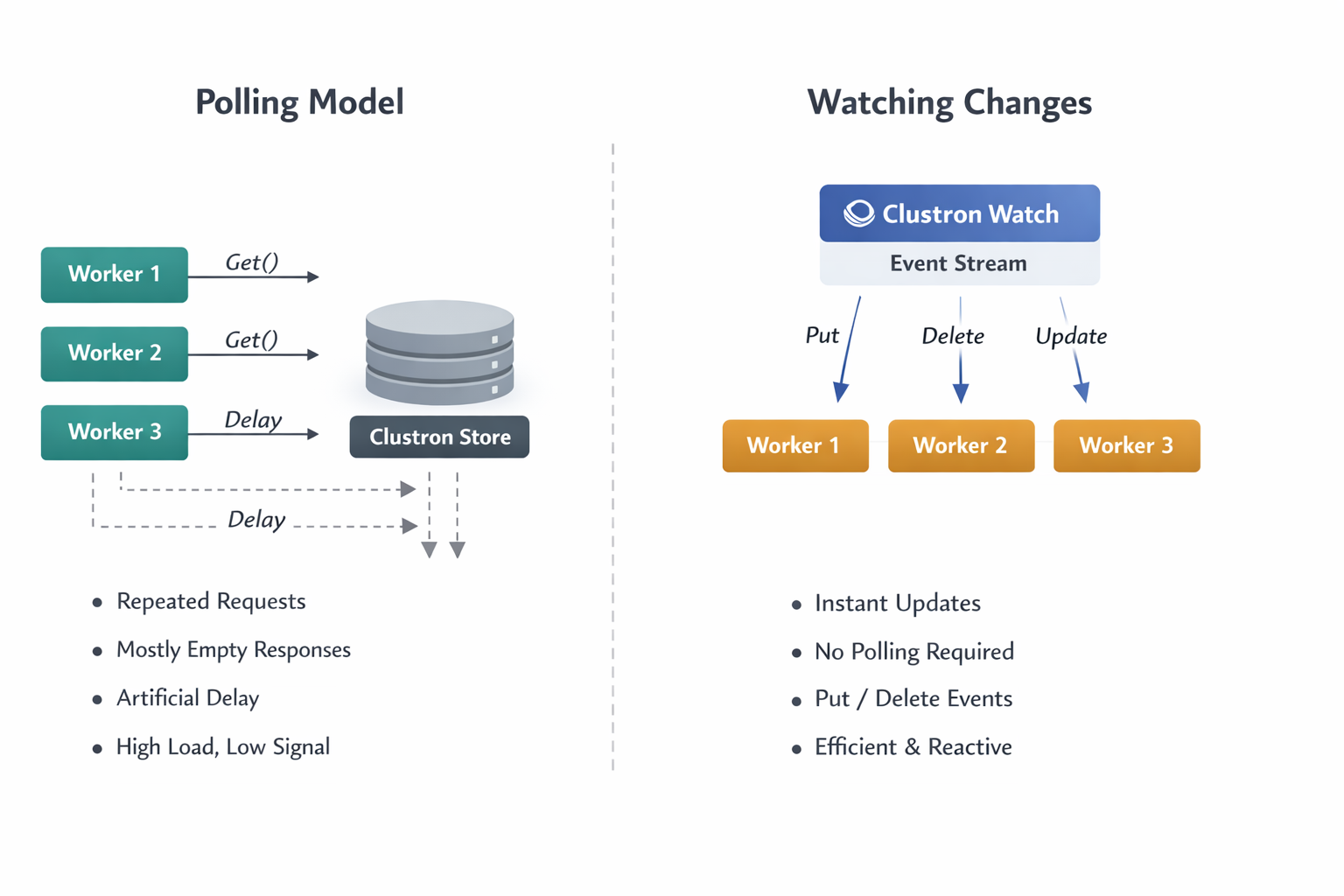
Polling introduces a fundamental inefficiency: you are repeatedly asking the system for changes that usually haven’t happened.
As you scale:
- Multiple instances begin polling the same data
- Each instance performs repeated reads, most of which return no useful information
- You introduce artificial latency — changes are only detected on the next polling cycle
- The system starts consuming resources simply to confirm that nothing has changed
This leads to a system that is technically correct, but operationally inefficient.
More importantly, polling forces you to make tradeoffs you shouldn’t have to make:
- Poll frequently → higher cost, lower latency
- Poll less frequently → lower cost, higher latency
There is no correct answer — only compromise.
A Different Model: Reacting Instead of Asking
The alternative is not just an optimization — it is a different way of thinking about systems.
Instead of asking:
“Has something changed?”
You design your system to respond to:
“Something just changed.”
This is the shift from a pull-based model to a push-based model.
In Clustron, this is implemented through Watch.
Introducing Watch: A Stream of State Changes
Clustron Watch allows you to subscribe to changes in the system and receive events as they happen.
At its core, Watch turns your data into a continuous stream of updates.
Watching a Single Key
var (subscription, initialRecord) = await client.Watch.WatchKeyAsync(
    "order:1001",
    new WatchOptions { IncludeInitialSnapshot = true },
    ev =>
    {
        Console.WriteLine($"{ev.EventType} → {ev.Key} = {ev.Value}");
    });
This does two important things:
- It gives you the current state (
initialRecord) - It subscribes you to all future changes
This combination is critical. Without it, you would have to manually fetch the current value and then subscribe — which introduces race conditions.
Snapshot + Streaming: A Correctness Guarantee
One of the subtle but essential aspects of Watch is the ability to include an initial snapshot.
When IncludeInitialSnapshot is enabled:
- You receive the current value at the time of subscription
- You then receive all subsequent updates in order
This ensures that:
- You do not miss existing state
- You do not miss future changes
- You do not need additional synchronization logic
In other words, Watch provides a complete and consistent view of state evolution.
Watching Collections: Moving Beyond Single Keys
While watching a single key is useful, most real systems operate on groups of related data.
Clustron supports this through prefix-based watching:
var subscription = await client.Watch.WatchPrefixAsync(
    "jobs:",
    new WatchOptions { IncludeInitialSnapshot = false },
    ev =>
    {
        Console.WriteLine($"Job update: {ev.Key}");
    });
This allows you to observe all changes within a logical group.
From an architectural perspective, this is where Watch becomes significantly more powerful:
- You are no longer reacting to individual values
- You are reacting to system-wide state transitions
Understanding the Event Model
Each change in the system produces a WatchEvent.
A typical event contains:
- The key that changed
- The type of change (
PutorDelete) - The new value (if applicable)
- A revision representing the version of the change
This revision is particularly important. It provides ordering and allows you to reason about the sequence of events across a distributed system.
Effectively, Watch gives you a log of state transitions, delivered in real time.
What This Enables in Practice
Once you adopt this model, several common problems become simpler.
Job Processing
Instead of polling for new work, workers react immediately when jobs are created or updated.
This removes idle cycles and reduces latency.
Cache Invalidation
Rather than relying on TTL or periodic refresh, caches can update themselves in response to actual changes.
This improves both freshness and efficiency.
Distributed Coordination
Systems that rely on shared state — such as leader election or lease ownership — benefit significantly from real-time updates.
Changes propagate instantly, allowing faster and more reliable coordination.
Presence and Monitoring
Tracking active components becomes trivial:
- When a node appears → you receive an event
- When a node disappears → you receive an event
No polling, no guessing.
Operational Considerations
Watch is designed for long-running, event-driven workloads.
A few important considerations:
Keep Handlers Lightweight
Your event handler should not perform heavy work directly.
Instead:
- Process quickly
- Delegate heavier tasks to background workers
Manage Subscription Lifecycle
Always stop subscriptions when they are no longer needed:
await subscription.StopAsync();
This ensures resources are released cleanly.
Understand Scope
- Watching a key → only that key produces events
- Watching a prefix → only matching keys produce events
Events are scoped and isolated, which prevents unintended cross-talk between components.
From Polling Loops to Reactive Systems
The shift from polling to watching is not just about performance.
It changes the structure of your application.
Polling systems are built around:
Loop → Check → Wait → Repeat
Reactive systems are built around:
Event → Handler → Action
This results in systems that are:
- More responsive
- More efficient
- Easier to reason about
Final Thoughts
Polling is often the simplest way to get started, and in small systems, it works well enough.
But as systems grow, the cost of polling becomes increasingly difficult to justify.
Clustron Watch offers a different approach — one where your system reacts to change rather than searching for it.
Stop asking your system if something changed.

Let it tell you when it does.
Getting Started
Try a simple watch:
await client.Watch.WatchPrefixAsync("orders:", null, ev =>
{
    Console.WriteLine($"{ev.Key} updated");
});
From there, start removing polling loops — one at a time.
You’ll quickly find that your system becomes not just faster, but fundamentally simpler.