Zaris 0.9.0 Is Here — and It's Generally Available


Today we're shipping Zaris 0.9.0, and with it, Zaris hits general availability. It's production-ready, cross-platform, and now backed by commercial support.
If you haven't run into it yet: Zaris is a distributed, in-memory key/value store for .NET. It's fast, replicated, and you can operate it from a browser, PowerShell, or straight from your app. This release is the culmination of that work — the point where "promising project" becomes "thing you can put in production."
Here's what's new.
Distributed replication & high availability
Zaris now splits data into partitions, with each partition kept on multiple nodes at a configurable replication factor. Lose a node, and the cluster keeps serving — replicas rebuild automatically once capacity comes back. Add or remove nodes and the partition map rebalances with no downtime.

One sizing note worth flagging: each partition needs RF distinct instances to stay durable, so make sure you're running enough nodes for every partition to reach RF. On Kubernetes, that means a pod count that's a multiple of RF — for RF2, an even count. That's why the defaults spin up a 4-node, RF2 cluster: two partitions, each with two copies on distinct nodes.
A Web Console for actually managing the thing
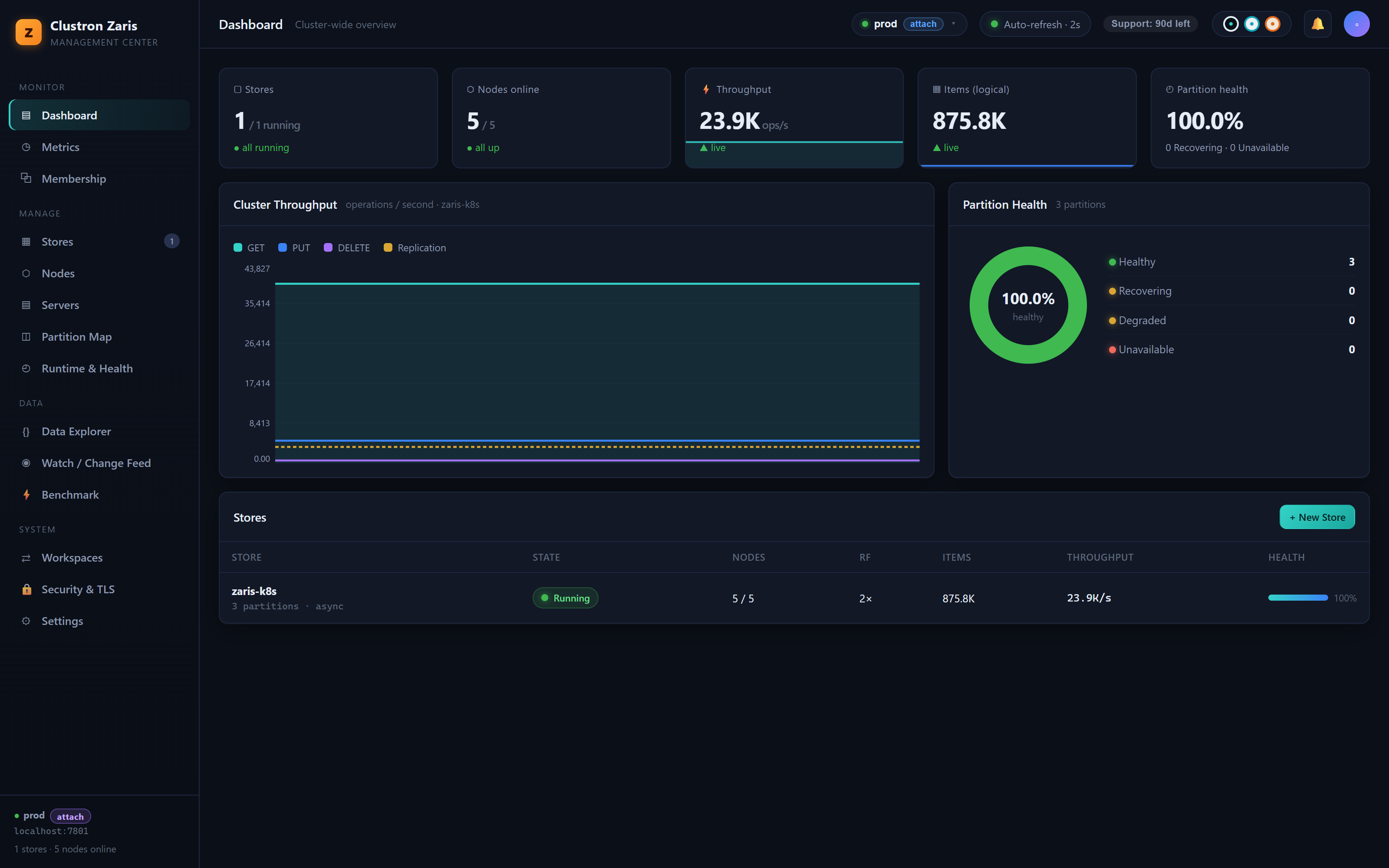
Previous versions leaned hard on the command line. 0.9.0 ships a browser-based management UI with live cluster, node, and partition health, throughput and latency metrics, and active connection views. You can create, start, scale, and inspect stores from it, manage TLS/CA certificates with guided steps, and switch between clusters using workspaces.
PowerShell tooling, redesigned
The AdminShell and ClientShell modules got a rework:
Workspace-based connections via New-ZrWorkspace / Use-ZrWorkspace mean no more manual manager wiring. Store lifecycle and scaling commands — New-ZrStore, Start-ZrStore, Add-ZrServer / Remove-ZrServer — cover the full operator loop. And Watch-ZrStoreMetrics gives you live operations with operator-first metric ordering, clearer connection errors, and automatic CA fetch.
A cleaner client API
Connection strings now work the same way everywhere — in-process, remote, Docker, or Kubernetes:
zaris://host:7861/store
(or zariss://… for TLS), with comma-separated seed hosts, automatic failover, and tokens supplied safely via env: or file:.
On top of that, you get a genuinely rich set of data operations: get/put/delete, compare-and-swap, bulk and batch operations, scan and search, prefix operations, transactions, leases, leader election, distributed counters, rate limiting, and a distributed job queue. If you're on ASP.NET Core, there are drop-in IDistributedCache and HybridCache providers, plus resilient, topology-aware clients with automatic retry and reconnection.
Runs wherever you run things
Windows gets a single installer covering the server, Management Service, Web Console, and PowerShell modules. Linux and Docker get published container images and a one-command Docker Compose cluster. And Kubernetes gets an official Helm chart with a StatefulSet, convergence-gated readiness, a PodDisruptionBudget, drain-safe termination, and support for external (out-of-cluster) client access with TLS.
Security & observability
TLS is supported for both client and node-to-node traffic, with pluggable CA trust — auto-issued, bring-your-own-CA, intermediate-signed, or pre-issued certificates — plus token-based authentication. OpenTelemetry support lets you export traces, metrics, and logs to any OTLP-compatible backend, and it's fully config-gated.
Getting started
NuGet:
dotnet add package Clustron.Zaris.SDK --version 0.9.0
Windows: grab clustron-zaris-0.9.0-win-x64.zip from the release page (verify against SHA256SUMS.txt).
Docker:
docker pull clustron/zaris-node:0.9.0
docker pull clustron/zaris-manager:0.9.0
Kubernetes (Helm):
helm install zaris oci://registry-1.docker.io/clustron/zaris --version 0.9.0 \
  -n zaris --create-namespace
Support and what's next
Zaris remains open and free to run. For teams putting it into production, commercial support plans and professional services are now available — see clustron.io/support.
Zaris is licensed under the Business Source License 1.1 (BSL 1.1).
Full release notes and downloads are on GitHub. We'd love to hear what you build with it.