Security built in, not bolted on
Authentication, authorization and encryption are part of the store — one trust fabric across the data plane and the console, configurable per store, with no extra services to run.
Three layers, one fabric
One built-in trust fabric secures node-to-node traffic, client connections, and the management plane — the same identity and authorization model across the whole cluster.
Authentication
Offline-verified bearer tokens — the node checks the signature against a cached cluster key, with no auth-server round trip on the hot path.
Authorization
Deny-by-default RBAC — subjects get roles, roles grant permissions on stores and admin operations. Nothing is allowed unless it is granted.
Encryption
Mutual TLS between nodes and server-auth TLS for clients, across four CA/trust models — turn it on per store.
Tokens, verified offline
Clients present a bearer token; the node verifies its signature against the cluster's cached public key — no call to an auth server on the request path. Keep the token out of the connection string with env: or file: references.
- No auth-server dependency on the hot path
- Tokens minted by the manager; scoped and expiring
- Safe indirection — secrets never sit in the URL
zariss://n0:7861/store?token=env:ZARIS_TOKENMutual TLS across the cluster
Node-to-node gossip and replication run mutual TLS; the client data plane is server-auth, where the client verifies the node and authenticates with a token. On Kubernetes the node leaf can carry a multi-SAN certificate so external clients validate too.
- Mutual TLS node ↔ node; server-auth for clients
- Automatic leaf renewal before expiry
- Turn it on per store — plaintext stays the default for dev
Four CA / trust models
From zero-PKI auto-issuance to mounting certificates your own CA issued — pick the trust model that matches your organization.
M0 · Auto / co-located
The manager mints a cluster CA and issues node leaves automatically. Zero PKI to run — great for getting secure fast.
M1 · Bring-your-own CA
Provide your own root CA; the cluster issues leaves from it, so Zaris chains to trust you already operate.
M2 · Intermediate CA
Issue from an intermediate under your corporate root; leaves present the full chain to the anchoring root.
M3 · Pre-issued leaves
Mount externally-issued leaves + CA as secrets (e.g. cert-manager). Zaris just loads and serves them.
Configure and audit it in one place
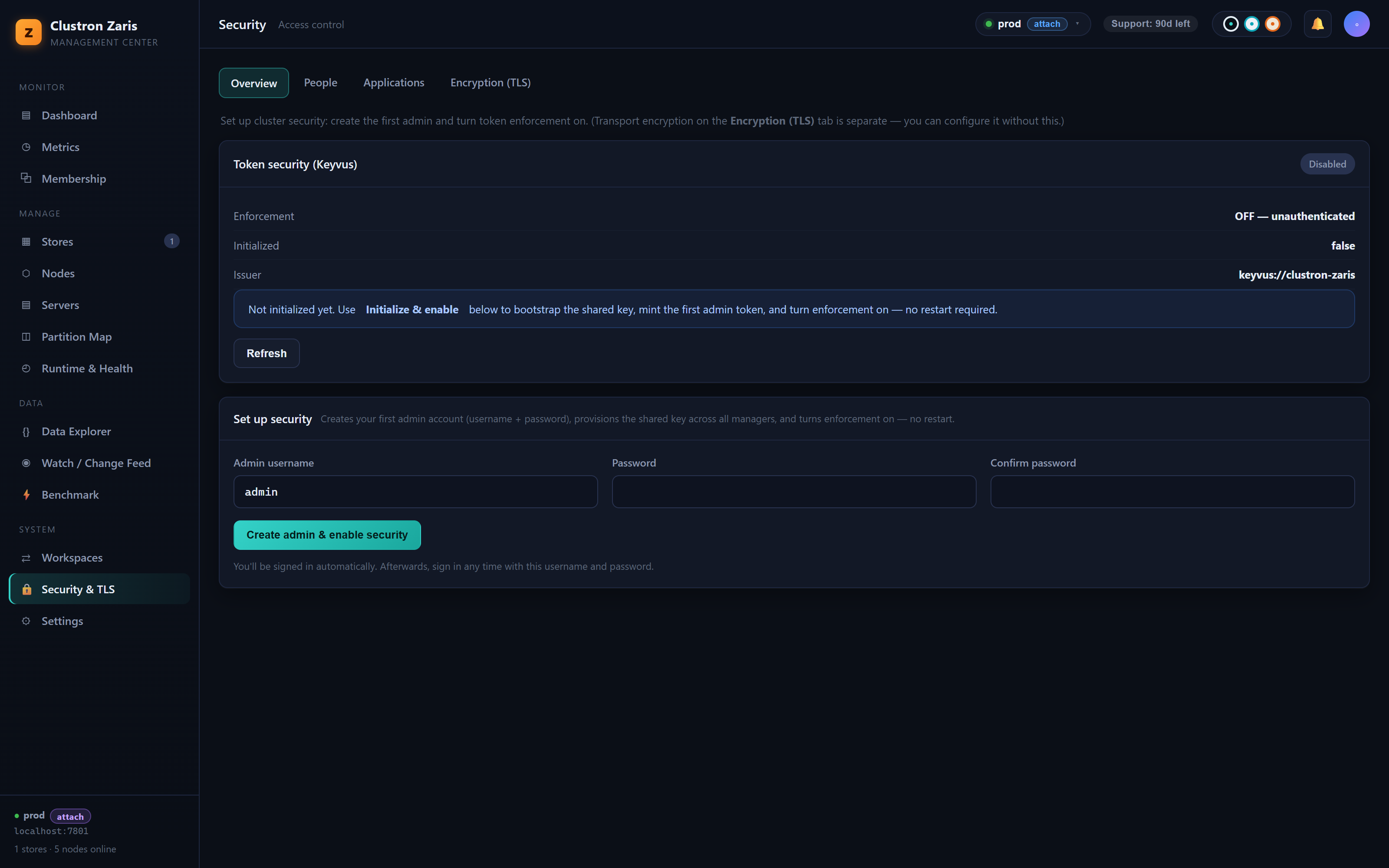
Initialize the cluster CA, mint enrollment tokens, pick the trust model, and see TLS status per node — all from the built-in Security & TLS view.
Secure by configuration, not by project
Turn on tokens, RBAC and TLS per store — no bespoke security service to build, run, and keep patched.