Distributed Locks Explained

A Practical Guide for .NET Developers
Introduction
As applications scale across multiple machines, coordination becomes one of the most challenging aspects of system design.
In a single-machine application, mutual exclusion is straightforward.
Developers can rely on language primitives such as lock in C#,
Mutex, or Semaphore to ensure that only one thread accesses a shared
resource at a time.
However, these primitives only work within a single process or machine.
Once applications run across multiple services or nodes, traditional
locking mechanisms no longer work. Two services running on different
machines cannot rely on a local lock statement to coordinate access to
shared state.
This is where distributed locks become essential.
Distributed locks allow services across a cluster to coordinate access to shared resources while ensuring that only one participant holds the lock at a given time.
Local Locks vs Distributed Locks
A typical local lock in C# looks like this:
private static readonly object _lock = new object();

public void ProcessOrder()
{
    lock(_lock)
    {
        Console.WriteLine("Processing order safely.");
    }
}
This works perfectly inside a single process.
However, if your application runs on multiple service instances,
each instance has its own _lock object. The lock no longer coordinates
work across the system.
Worker A → lock acquired Worker B → lock acquired Worker C → lock acquired
All workers proceed simultaneously, defeating the purpose of locking.
Distributed systems require a shared coordination mechanism.
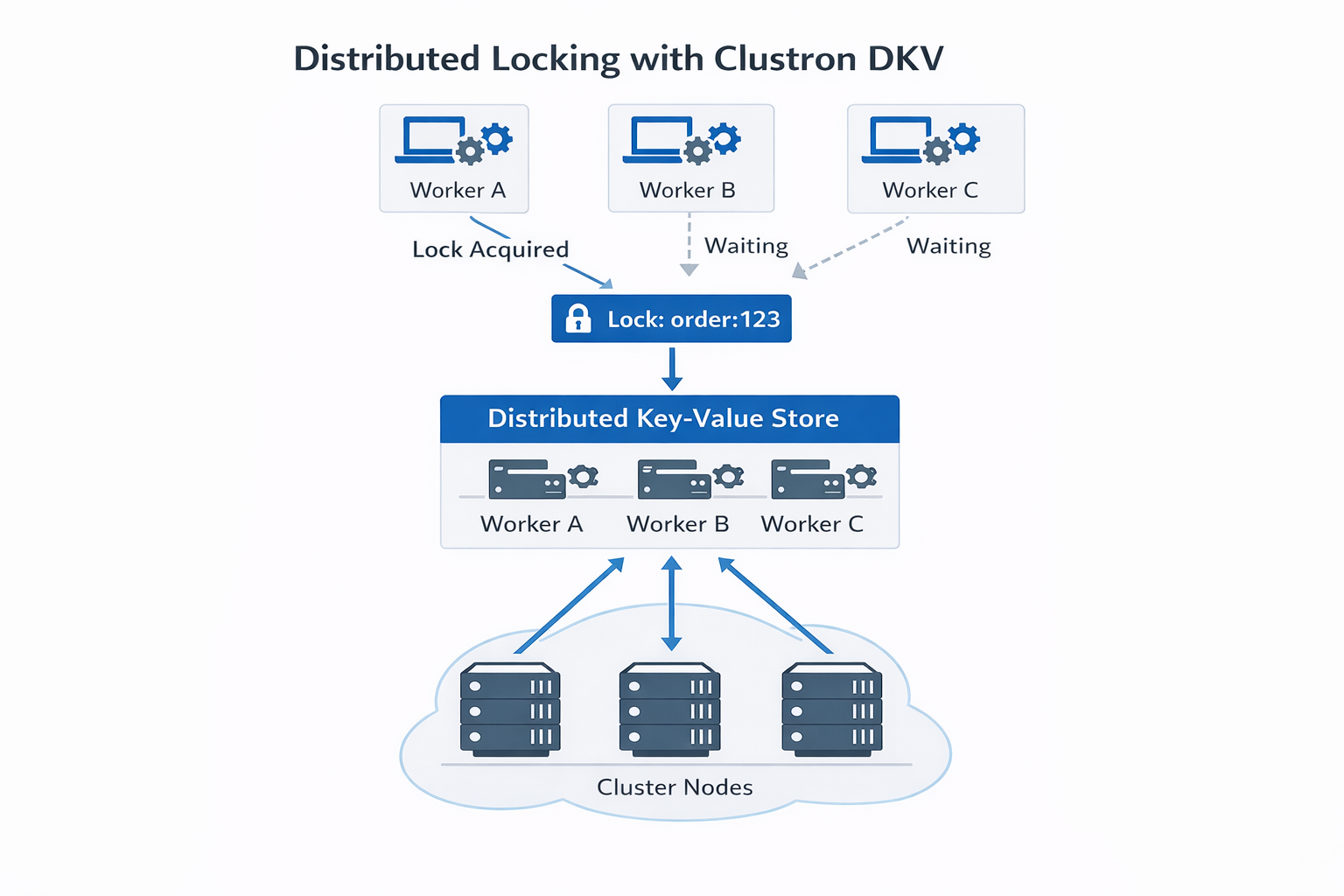
The Idea Behind Distributed Locks
A distributed lock uses a shared system to represent lock ownership.
Instead of locking memory, a node records lock ownership in a distributed coordination system such as:
- a distributed key‑value store
- a coordination service
- a distributed cache
Example concept:
Lock Key: order:123 Owner: worker‑1
If another worker attempts to acquire the same lock, the operation fails until the lock is released or expires.
Real World Scenario: Distributed Invoice Processing
Imagine a cluster of workers processing invoices.
Worker A Worker B Worker C
All workers scan for pending invoices.
Without locking:
Worker A → processes invoice #101 Worker B → processes invoice #101 Worker C → processes invoice #101
The same invoice could be processed multiple times.
A distributed lock ensures that only one worker processes the invoice.
Distributed Locks with Clustron DKV
Clustron DKV provides built‑in primitives for distributed coordination.
Locks are managed through the Locks API, and operations on locked keys must include the correct lock handle.
Acquiring a Lock
A client first acquires a lock for a specific key.
var locks = ((IDkv)client).Locks;

var key = "order:123";

var lockHandle = await locks.AcquireAsync(key, TimeSpan.FromSeconds(10));

if (lockHandle == null)
{
    Console.WriteLine("Failed to acquire lock.");
    return;
}

Console.WriteLine("Lock acquired.");
The returned lock handle represents ownership of the lock.
Performing Operations Under the Lock
Once a lock is acquired, operations must include the lock handle.
var result = await client.PutAsync(
    key,
    "processed",
    Put.WithLock(lockHandle.Handle));

if (result.IsSuccess)
{
    Console.WriteLine("Value updated safely.");
}
Only the lock owner can modify the value.
Reading with the Lock
Reads can also respect the lock ownership.
var value = await client.GetAsync<string>(
    key,
    Get.WithLock(lockHandle.Handle));

if (value.IsSuccess)
{
    Console.WriteLine($"Value: {value.Value}");
}
Competing Operations Without the Lock
If another worker attempts to modify the key without the lock, the operation fails.
var attempt = await client.PutAsync(key, "new-value");

if (!attempt.IsSuccess)
{
    Console.WriteLine($"Operation rejected: {attempt.Status}");
}
Result:
KvStatus.Locked
This prevents concurrent modification of the same resource.
Releasing the Lock
Once the work is finished, the lock can be released.
await lockHandle.ReleaseAsync();

Console.WriteLine("Lock released.");
After the lock is released, another worker may acquire it.
Example Cluster Workflow
Worker A → Acquire Lock → Success Worker B → Acquire Lock → Failed Worker C → Acquire Lock → Failed
Worker A → Update Key Worker A → Release Lock
Only one worker performs the operation, ensuring correctness.
Handling Failures
Locks in Clustron are time‑bound.
When acquiring a lock, a duration must be specified:
await locks.AcquireAsync(key, TimeSpan.FromSeconds(10));
If the client holding the lock crashes or disconnects, the lock eventually expires, allowing another worker to acquire it.
This prevents locks from remaining permanently held.
Best Practices
When implementing distributed locks:
- Keep critical sections short
- Avoid global locks when possible
- Partition locks by resource
- Always design for failure scenarios
Final Thoughts
Distributed locks are one of the most fundamental coordination primitives in distributed systems.
They allow services running across multiple machines to safely coordinate access to shared resources while preserving system correctness.
Platforms like Clustron DKV simplify this by providing built‑in locking primitives, atomic operations, and strong consistency guarantees.
In the next article, we will explore another essential distributed systems primitive:
Leader Election.