Distributed Caching in .NET
Caching is one of the most effective ways to improve the performance of
an application.
Most .NET applications start with a simple in‑memory cache using
MemoryCache or IMemoryCache. This works perfectly when the
application runs on a single server.
However, modern applications rarely run on a single machine.
When applications scale horizontally across multiple instances, in‑memory caching stops working reliably. Each instance maintains its own cache, which means the application state becomes inconsistent across the cluster.
This is where distributed caching becomes essential.
The Problem with In‑Memory Caches
Consider a typical ASP.NET application deployed behind a load balancer.
          Load Balancer
                |
     ---------------------------
     |            |            |
  Server A     Server B     Server C
Each server has its own memory cache.
If a request updates cached data on Server A, the caches on Server B and Server C remain outdated.
This leads to several problems:
- inconsistent application state
- stale cache entries
- duplicate cache warmups
- unpredictable behavior
To solve this problem, the cache must be shared across all nodes.
What is a Distributed Cache?
A distributed cache is a centralized or clustered cache that can be accessed by multiple application instances.
Instead of storing cached data inside the application process, the data is stored in a distributed key‑value store.
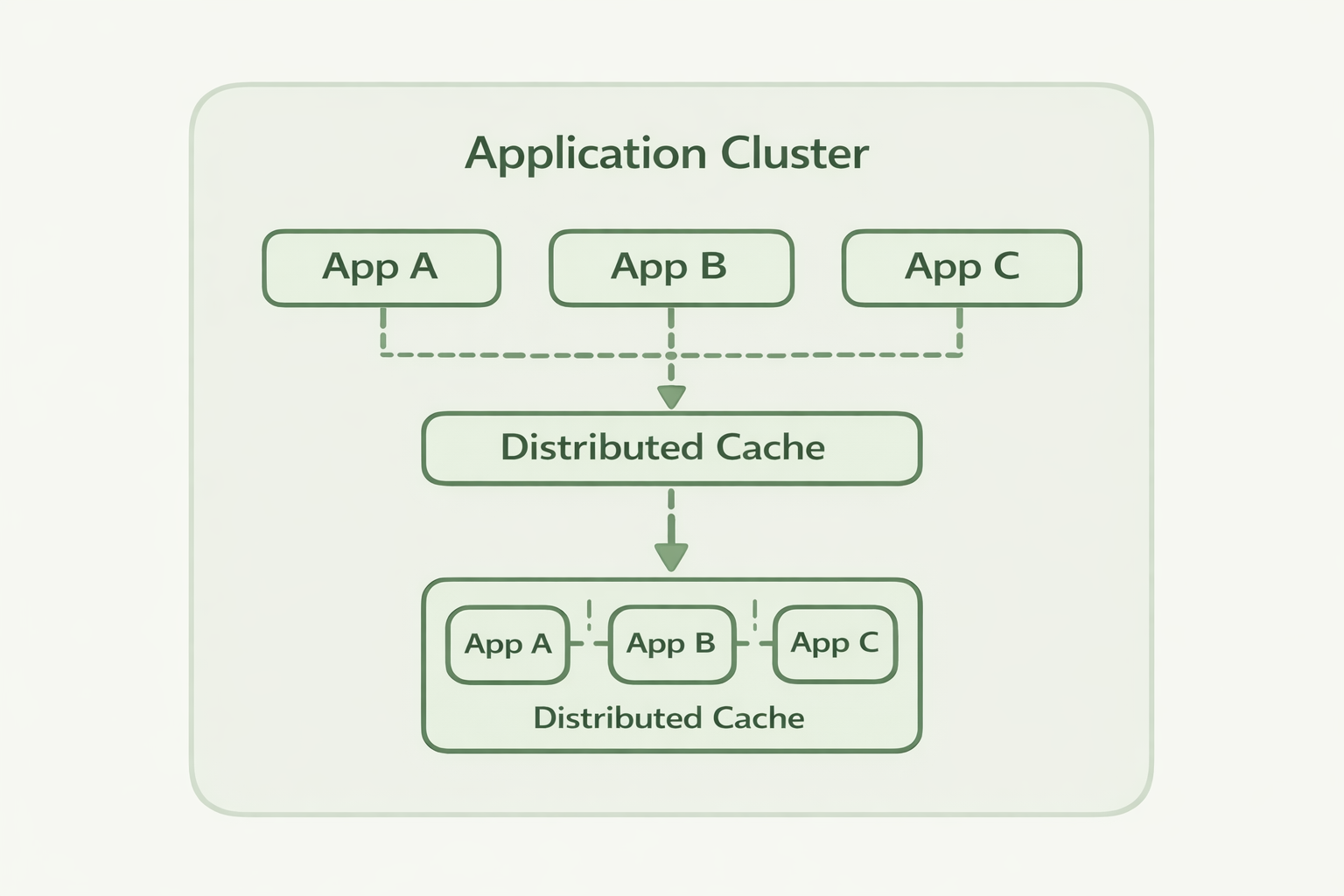
           Application Nodes

        App A     App B     App C
          |         |         |
          +---------+---------+
                    |
            Distributed Cache
All application nodes read and write cache entries from the same distributed store.
This ensures:
- consistent cached data
- shared application state
- better scalability
Basic Distributed Cache Example in .NET
A distributed cache is typically used through an abstraction such as
IDistributedCache.
Example:
public class ProductService
{
    private readonly IDistributedCache _cache;

    public ProductService(IDistributedCache cache)
    {
        _cache = cache;
    }

    public async Task<string?> GetProductAsync(string id)
    {
        var cached = await _cache.GetStringAsync(id);

        if (cached != null)
            return cached;

        var product = await LoadProductFromDatabase(id);

        await _cache.SetStringAsync(id, product);

        return product;
    }

    private Task<string> LoadProductFromDatabase(string id)
    {
        return Task.FromResult($"Product {id}");
    }
}
The application first checks the cache. If the value is missing, the data is loaded from the database and then stored in the cache.
This pattern is called cache‑aside caching.
Common Distributed Cache Solutions
Several technologies provide distributed caching capabilities.
Redis
Redis is one of the most widely used distributed caches.
It provides:
- key‑value storage
- high performance
- in‑memory operations
However, Redis often requires additional components when used for distributed coordination.
Database‑Backed Caches
Some applications use relational databases as caches.
While simple, this approach introduces:
- database contention
- reduced performance
- limited scalability
Distributed Key‑Value Platforms
Modern distributed systems often use distributed key‑value platforms that provide both caching and coordination primitives.
These systems support:
- distributed caching
- distributed locks
- leader election
- change notifications
- cluster coordination
Using Clustron as a Distributed Cache
Clustron provides a distributed key‑value platform designed for .NET applications.
Because it runs as a distributed cluster, all application instances interact with the same shared data store.
Example:
using Clustron.DKV.Client;

var client = await DKVClient.InitializeRemote(
    "teststore",
    new[]
    {
        new DkvServerInfo("localhost", 7861)
    });

await client.PutAsync("product:1", "Laptop");

var value = await client.GetAsync<string>("product:1");

Console.WriteLine(value);
In this example:
- application nodes connect to the cluster
- data is stored in the distributed store
- all nodes see the same data
This allows the cache to remain consistent across the entire cluster.
When to Use Distributed Caching
Distributed caching is especially useful in systems that:
- run multiple application instances
- process high request volumes
- rely heavily on database reads
- require shared application state
Typical use cases include:
- ASP.NET web applications
- microservices architectures
- background processing systems
- API platforms
Summary
In‑memory caching works well for single‑server applications, but modern distributed systems require a shared caching layer.
Distributed caching allows multiple application instances to share the same cached data, improving scalability and consistency.
Platforms such as Clustron provide a distributed key‑value store that makes it easy to implement distributed caching and coordination in .NET applications.